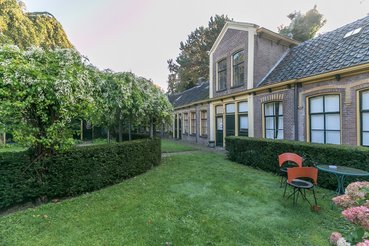
Groningen is full of authentic courtyards. Separated from the bustling city center by often closed entrance gates, as many as thirty courtyards or almshouses lie hidden. Examples include the St. Anthonygasthuis, the Pepergasthuis, and the Pelstergasthuis. Did you know that the Hortusbuurt is even among the neighborhoods in the Netherlands with the highest density of courtyards and almshouses? One of the courtyards gracing the neighborhood is located on the Kleine Rozenstraat.
A courtyard named Het Middengasthuis is situated on the south side of the Kleine Rozenstraat. This almshouse dates back to 1873 and was founded by the Algemeen Diakengezelschap. A deacon is a member of the clergy ranked directly below a priest, assisting the priest during church services and overseeing ecclesiastical poor relief. The Algemeen Diakengezelschap consisted of Dutch Reformed deacons and former deacons who dedicated themselves to establishing and maintaining ‘charitable institutions’ for the poor.
In 1867, the Algemeen Diaken Gezelschap decided to found an almshouse for ‘respectable, well-behaved craftsmen and servants, too poor to afford a place in an almshouse with a high entry fee and yet too well-off to seek a place in the diaconal almshouse’.
Three years later, two dwellings and a garden were purchased on the Kleine Rozenstraat. After the Society received royal approval on November 7, 1872, the buildings were demolished. In the following year, 1873, 21 new living quarters were constructed. Reformed individuals aged 55 and older could purchase a place in the almshouse. Through further acquisitions over the years, the Middengasthuis was expanded by six houses (current numbers 8 to 14), but due to its success, it still became too small. Consequently, a second Middengasthuis was established in the Grote Leliestraat.
Until the Second World War, both almshouses met a specific need, but this gradually changed after the war. The courtyard increasingly fell under social housing as the criteria for residents became more blurred.
In 1968, the Middengasthuizen, together with several other almshouses, formed the Verenigde Groninger Gasthuizen. A few years later, the almshouse on the Kleine Rozenstraat was sold to a construction company. In 1978, the municipality declared the almshouse ‘beyond renovation’, threatening the courtyard with demolition. Fortunately, following protests from residents and the neighborhood, the municipality relented.
Since 1981, Gruno (now Nijestee) has been the owner of the almshouse. Recently, the housing corporation decided to sell vacant rental properties in and around the courtyard on the open market.
Pandomo Makelaars regularly offers courtyard properties for sale. Click here for our current listings!